Posted on

Focus on eyes! – Men

One of the most important steps in treating male skin is to select a good eye cream, as ageing is first noticed in the eye area with the appearance of ‘ crows feet’.

Here are a few eye creams preferred by men which will assist with fine lines and wrinkles in the eye area (crows feet), which is a common skin concern in men.

Obagi ELASTIderm Eye Serum

Elastiderm eye serum refreshes the appearance of the delicate skin around the eye area. It reduce the appearance of periorbital fine lines and wrinkles and improves the appearance of dark under-eye circles.

It is a lightweight serum in a rollerball dispenser

Neostrata Skin Active Intensive Eye Therapy

Skin Active Intensive Eye Therapy is an advanced SynerG formulation aimed at building and plumping the delicate skin in the eye area. Apple Stem Cell Extract protects the longevity of the skin cells, while Peptides stimulate collagen production.

It is a lightweight cream in a pump dispenser.

SkinCeuticals A.G.E. Eye Complex

A.G.E. Eye Complex is a specially formulated eye cream that improves the appearance of puffiness, dark circles and crow’s feet, associated with the formation of advanced glycation end products during the ageing process. There is immediate enhanced radiance of tired, dull eyes.

It is a cream which is rapidly absorbed into the eyelid skin and comes in a jar.

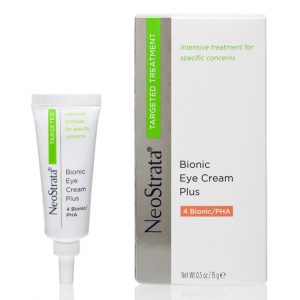
Neostrata Bionic eye cream plus

Bionic Eye Cream Plus is a multi-functional eye cream that targets dark under-eye circles and reduces fine lines, wrinkles and puffiness. Vitamin K diminishes the appearance of dark circles, while the Lactobionic Acid prevents collagen breakdown, making the skin look and feel firmer.

It is a lightweight cream in a tube.

If you are still not sure about which eye cream to select or need advice on your skincare regimen, email Annika on [email protected].

Posted on

Ingredients to look for in skin brightening products

The mainstay of treatment of hyperpigmentation is topical therapy, and skincare procedures like chemical peels and dermal needling. Combining products with different modes of action gives better results.

Skin brightening or lightening ingredients target uneven skin tone, dark spots, sun spots, post inflammatory hyperpigmentation(PIH) and melasma. The results are variable from person to person and there is much ongoing research to find effective yet safe ingredients. Use of many of these products is limited by the potential for irritating the skin and in this way worsening hyperpigmentation.

The gold standard for skin lightening is hydroquinone which is only available in prescription products in South Africa. Although it is very hard to treat hyperpigmentation on the skin we look at some of the ingredients with established efficacy and list some of the skincare products available.

Kojic Acid

Kojic acid is a frequently used and well studied skin lightening agent. It is generally well tolerated in topical applications.
MOA: Kojic acid inhibits the enzyme tyrosinase decreasing the production of melanin pigment.
It is also a potent antioxidant.

Products:
Neoretin Gelcream SPF 50
This product contains Kojic acid and a sunscreen.
Neoretin booster serum
This is a lightweight, rapidly absorbed formulation containing Kojic acid and other active ingredients which inhibit melanin synthesis. Retinsphere technology increases epidermal turnover.
SkinCeuticals metacell renewal B3
Metacell Renewal B3 contains Kojic acid and other active ingredients to target the early signs of ageing and hyperpigmentation.
NeoStrata Enlighten Pigment Gel This potent formulation contains Kojic Acid, Liquorice extract, citric acid and multiple other active ingredients to target hyperpigmentation.

Liquorice Extract


Liquorice extract is a natural skin lightening alternative to hydroquinone. It contains an active ingredient called glabridin, and is suitable for sensitive or rosacea prone skin as it also decreases redness and inflammation.
MOA: Liquorice extract inhibits the enzyme tyrosinase, increases epidermal turnover and is anti-inflammatory.

Products:
Lumixyl brightening crème
This gentle skin brightening product may be used while pregnant or breastfeeding. It improves the appearance of hyperpigmentation without irritation.

Citric acid

Citric acid is an effective product for treating several skin problems including mild acne, hyperpigmentation, blocked pores, sun damage and wrinkles. Citric acid is found in chemical peels, toners and skincare products.
MOA: Citric acid increases epidermal turnover and has antioxidant effects.

Products:
Neostrata Enlighten Pigment controller
This product is specially formulated with citric acid and retinol to target hyperpigmentation and sun spots.

Arbutin

Arbutin is a glycosylated hydroquinone extract. Arbutin has been considered one of the safest and most effective skin lightening agents. Its effects are optimised when combined with other substances like Vitamin C, Liquorice, glycolic acid and Kojic acid.
MOA: Arbutin inhibits the enzyme tyrosinase,decreasing the production of melanin pigment.
The active ingredient is slowly released making it suitable for those with sensitive skin.

Products:
Obagi Nu-Derm Blend FX
This product containing Arbutin penetrates deeper as the molecules are smaller. It is able to reach the basal layer of the epidermis and inhibit tyrosinase.
Obagi Nu-derm Clear FX
This light weight serum containing Arbutin targets epidermal hyperpigmentation.

Ellagic acid

Ellagic acid is a naturally occurring antioxidant found in fruits and berries that improves hyperpigmentation. It is gentle on the skin and safe to use.
MOA: Ellagic acid inhibits the enzyme tyrosinase, decreasing the production of melanin pigment.
It is safe to use on sensitive skin.

Products:
SkinCeuticals Advanced Pigment corrector
This product is formulated with ellagic acid and salicylic acid to target areas of hyperpigmentation and promote an even skin tone.

Other ingredient recommendations which have been shown to reduce melanin production include White Mulberry Extract, niacinamide, and azeleic acid
Vitamin C is a potent antioxidant which indirectly inhibits the enzyme tyrosinase leading to decreased melanin production. The anti-inflammatory effect reduces cell injury and pigment production.
Retinoic acid has many anti-ageing skin benefits. It reduces hyperpigmentation by increasing epidermal turnover.

Note from Dr. Kesiree

The management of hyperpigmentation requires a consistent and dedicated treatment routine. The results may be slow and vary between individuals. Your regimen should include preventative as well as treatment measures. Follow up your intensive treatment phases with a good maintenance regimen to maintain results.
Seek the advice of a dermatologist to assist with integrating topical treatments and skincare procedures.

Posted on

What does SPF mean?

SPF or sun protection factor is a measure of protection against only UVB.
An SPF of 30 means that you will be able to stay in the sun 30 times longer without burning, than you would be able to without wearing the sunscreen.

This does not equate to 30 min, and most importantly is different for each person, as we all burn at different rates depending on our skin type.
SPF is measured in a test environment which is nothing like real life.
It does not take into account sweating, environmental factors and the varying application by the sunscreen user. In a test environment sunscreen is applied very thickly, at 2mg of sunscreen per square centimeter. The quantity that is actually applied by people is closer to 0.5mg per square centimeter. So we are never really getting the same protection as on the label.

While it is true that SPF15 filters out 93.3% of UVB, SPF30 96.7% and SPF50 98.3%, making it seem that there is very little benefit in using the higher SPF, one needs to consider that only the amount of UV light reaching your skin is important. If you look at it this way then SPF 15 allows 6.7% of UVB to reach your skin while SPF 50 only allows 1.7% of UVB.

Dermatologist associations worldwide recommend you wear at least an SPF of 30.

SPF says nothing about the UVA cover of a sunscreen. There is at present no universally applied measure of UVA protection. Look for UVA with a circle around it on your sunscreen bottle. This denotes high UVA protection.

A final word is that we must remember that 80% of sun exposure is incidental and happens during the course of our day to day life, while we are not actively “lying down to tan”. UVA penetrates through windows and causes sun damage without causing sunburn.

If you find that you are getting sunburned, and notice the increasing appearance of “sun spots”, you are getting more exposure than you thought and need to re-look at your sun protection measures.

Posted on

Sun protection – how to stay safe and when to worry

UVB(ultraviolet B), UVA (ultraviolet A) and visible light make up a small, yet significant portion of the electromagnetic spectrum of light entering the earths atmosphere.

UVB causes us to burn while UVA, which has a longer wavelength, penetrates deeper into the skin. It does not cause sunburn, but is most significant in causing photo-ageing (ageing from the sun) and skin cancer. Photo-ageing and skin cancer are both consequences of excessive cumulative sun exposure and are almost always talked about together.

Sunlight is certainly not all bad, and generally induces a sense of well-being, decreases the appetite, improves libido and assists with the synthesis of vitamin D. We also use controlled light sources of UVB and UVA to treat a range of skin conditions like psoriasis and eczema.

The harmful effects of UV light can be divided into:
Acute (short term) and Chronic (long term effects).
Acute exposure to UVB causes sunburn which damages the DNA of our skin cells. Acute exposure to UVA suppresses the immune system in our skin which protects us against skin cancer and skin infections.
Chronic exposure to UVA causes skin ageing and both UVA and UVB cause skin cancer.
Compare the skin on sun exposed areas of your body to non sun exposed skin if you would like to see the added effect of photo-ageing to the normal process of ageing, which we call chronological ageing.
Features of photo-ageing include wrinkles, sagging skin, yellowing of the skin, pigmentation, freckles, broken veins and easy bruising.
Solar (actinic) keratosis, basal cell cancer, squamous cell cancer and melanoma are examples of precancerous and cancerous lesions.

While moderate and responsible exposure to the sun is good for your well-being, it is not possible to tan without damaging skin cells, leading to accelerated ageing, and increasing your risk of skin cancer.

Tips for sun protection
1.Minimise your exposure to direct sunlight and ensure that you never allow yourself to burn. Always seek the shade if you have to be outdoors. In general, peak UV exposure is between 11am to 3pm, but this varies with the season and location.
2. Wear a wide brimmed hat, sun protective clothing and sunglasses. Covering up is the best protection from the sun.
3. Wear sunscreens on areas that cannot be covered.
Apply sunscreen, liberally, evenly and repeatedly.
Apply sunscreen 30 min before you leave the house and reapply every 2-4 hours especially after sweating or swimming.

Sunscreens past and present.
Sunscreen technology has come a long way since the greasy, cosmetically unacceptable formulations that made you sticky and grey.
Sunscreens come in creams, lotions, sprays, milks, oils and make up compacts. They are available in tinted, non tinted and sheer forms.
The sunscreen industry has made it virtually impossible for you not to find a sunscreen you will be happy with as the worldwide consensus is the best sunscreen for you is the one that you will wear!

Sunscreen active ingredients are divided into categories of physical and chemical blockers. These protect against different wavelengths of light in the spectrum and are often found in combination to ensure maximum protection and stability of the product.

Physical blockers, titanium dioxide and zinc oxide have broad spectrum cover and are suitable for children and sensitive skins.
Older sunscreens only protected against UVB, while the newer sunscreens almost always cover UVB and UVA.

Posted on

What is a skin peel?

Superficial skin peels involve the application of a chemical peeling agent to the skin in order to remove the damaged outer layers, resulting in the appearance of new, regenerated skin which is smooth-textured, even-toned and less wrinkled. These controlled peels range in strength from superficial peels, which can be performed by doctors and aesthetic therapists, to much deeper peels which are only conducted by medical professionals.


Superficial chemical peels are generally safe because they only affect the epidermis and can have beneficial effects on an array of skin concerns, including acne, pigmentation, melasma, sun damage and ageing. Even though penetration is superficial, positive changes can also be seen in the deeper layer of the skin, with the stimulation of collagen production in the dermis. Collagen is important for anti-ageing and skin repair.

There are a number of ingredients that can be used to peel the skin, but the most commonly used are alpha hydroxy acids (AHA), eg. glycolic, lactic, citric and malic acids, and Beta Hydroxy acids (BHA), eg. Salicylic acid.

AHAs occur naturally in sugar cane, milk, and a variety of fruits, and have been used on the skin for thousands of years, beginning with the Ancient Egyptian women who would bathe in sour milk to smooth their skin.

Patients usually tolerate the peel well, and will experience a tingling or itching sensation, or a feeling of warmth. The degree of tingling or itching is usually indicative of the overall condition of the skin, ie if the client is using good homecare products and the skin is well-hydrated, she may not feel the peel as intensely as a patient that has not looked after her skin well. Once the peel has been ‘neutralised’ the skin will once again feel comfortable, and only perhaps a little warm. This is due to increased blood circulation.

When the acids are applied to the skin, they break down the bonds between dead skin cells and the skin then sloughs off these cells over the next 2-3 days. As a result, the patient may experience a sand-papery texture, mild flaking or a tight feeling of the skin.  It is important at this time to keep the skin well-hydrated and to apply a good quality sunscreen.

Following this short period of dryness or flaking, a more youthful, healthier looking skin becomes visible. So the skin typically looks it’s best 3-4 days post treatment, with a beautiful radiant glow!

Post peel care is vitally important. The skin has been sensitized by the peel, so excessive sun exposure must be avoided for the next 48 hours. Heavy cardiovascular exercise should be avoided for 48 hours as perspiration will burn the skin, and will make the skin more vulnerable to bacterial infection. Do not use products containing active ingredients, like Vitamin A for 3 days pre- and post-peel.

It is always advisable to do a series of skin peels in order to achieve best results on specific skin concerns, and consult with your therapist regarding other aesthetic procedures like laser, microneedling and microdermabrasion, and how to structure good in-clinic routine treatments for optimal results.

Posted on

Understanding Sensitive Skin

Thousands of ingredients are used by the cosmetics and skincare industry, including pure compounds, plant extracts, oils and waxes, preservatives, surfactants, detergents and polymers. While all ingredients used are tested for safety, some patients may still experience reactions to some of them.

There are 2 types of reactions that may be seen.

The most common is the primary irritant contact reaction. This tends to be of rapid onset following contact with the irritant ingredient, and causes mild discomfort, redness and possibly scaling of the skin.

An allergic contact reaction on the other hand, is often delayed, persistent, and sometimes severe.

More than 50% of the general population perceives their skin as sensitive, and this is often related to impaired barrier function. The human skin is constantly exposed to environmental stress, including changes in humidity, extreme temperatures, pollution, and daily topically-applied products, including soaps and household chemicals. These factors can lead to the removal of the epidermal barrier lipids, thus leading to impaired barrier function. Ingredients that have been used in the past can become irritating to the skin, because of the increased penetration into the skin.

A wide variety of procedures and ingredients can act as irritants.

Mechanical, chemical and environmental factors can act alone or in combination to produce skin irritation.

Mechanical factors: cosmetic procedures such as waxing, laser therapy, dermabrasion

Chemical factors:  solvents, some acids, alkaline substances such as soaps

Environmental elements: air-conditioning, food allergies, prolonged exposure to water.

These factors contribute to skin irritation, the disruption of the skin barrier and increased trans-epidermal water loss.

Other common irritants in cosmetic formulations are fragrances, preservatives and some botanical ingredients.

In order to manage cosmetic intolerance syndrome, we need to focus on maintaining and supporting the integrity of the skin barrier

If the skin barrier is working well, it will retain water effectively. If it is defective the skin will become dry and dull, and this means that irritants can penetrate more rapidly, causing sensitivity.

Much like a security guard for your skin, the barrier is there to stop potential irritants from passing through, and to protect what lies beneath!

So follow these simple steps to restore and maintain your skin barrier function:

  1. Avoid foaming cleansers containing sodium laureth sulphate. Avoid astringents, like alcohol on the skin
  2. Avoid physical granular scrubs or skin buffers, as these are too harsh on the skin
  3. Do not wash the skin with overly hot water
  4. Look for products containing active ingredients that are proven to be safe and effective.
  5. Keep the skin well hydrated. Use barrier repair creams containing cholesterol, ceramides, essential and non-essential fatty acids.

It is important to note that if you have a ‘sensitive’ skin, you could possibly have a skin condition like rosacea or eczema. It is best to consult with a dermatologist for a proper skin evaluation and diagnosis.